Live Laugh Love Lichen
LiveLaughLoveLichen, 2026. webdesign by Hanna Hofmann & Sanne Scheepmaker
x
Live Laugh Love Lichen · Pavilion

A structure that travels, changes and adapts.

The pavilion was designed as a temporary, travelling structure: a lightweight framework that can be assembled, disassembled and rebuilt in different places rather than belonging to one fixed site.

Its frame stays legible and reusable, while its outer shell can change each time it moves. New artworks, materials and surfaces can be attached to it, allowing the pavilion to take on a different appearance in response to each location, collaboration and exhibition.

Like lichen adapting to the conditions of its environment, the pavilion keeps its underlying structure while its visible body can continually transform.

Frame C — main drawingPDF ↗
Frame C — connection detailPDF ↗
Pavilion H — round-tube elementsPDF ↗
Frame I — main drawingPDF ↗
Frame I — connection detailPDF ↗
Frame L — main drawingPDF ↗
Frame L — connection detailPDF ↗
Pavilion design by Prima Mathawabhan & Laura Isselhorst · © 2026
Enlarged pavilion architectural drawing
x

Live Laugh Love Lichen is a space exploring lichens, their perception of the environment and their role in caring for the ecosystem as a symbiotic community. Lichens become our central point of reference, as they form connections in order to exist. They are not plants, but rather symbiotic communities comprising fungi and algae or bacteria. Their symbiosis is based on connection, mutual dependence and slow growth. Through arts of change, we have united our artistic interests through collaborative, transdisciplinary work.

These principles are embodied within the pavilion we built, which becomes a structure for lingering, growing and intertwining. Here various disciplines come together, including architecture, text, sculpture, digital, textiles, performance and co-creation with the audience.

The pavilion can be seen as the structural fungus of a lichen community, which is allowed to grow in partnership with algae and bacteria. Only together can they survive under the most challenging conditions and support one another. Just as with lichens, our group of Gesellen strives for a caring union.

For us, care means sharing attention and knowledge. New perspectives can change the way we perceive our environment and how we respond to it. Our work has emerged from a sense of community and remains open to whatever grows from it.

As part of the arts of change Symposium, we developed a performative workshop entitled becoming lichen, in which explore our relationship with lichens through a body-oriented practice in public space. We invite participants to linger in the pavilion, breathe and become intertwined with it.

a project by Gesellen
(Hanna Hofmann, Laura Isselhorst, Prima Mathawabhan, Hannah Neuhaus, Sanne Scheepmaker)

x

50 lichens urban myths and fun facts

curated by Prima Mathawabhan

  1. Lichens are among the longest-lived organisms and can survive for thousands of years
  2. Lichens are also the slowest-growing organisms in the world.
  3. Lichens only need good air to grow.
  4. Lichens are not plants.
  5. Lichens are bioindicators of clean air.
  6. Lichens can be eaten.
  7. Lichens are the life form that first brought the term symbiosis into biological context.
  8. Lichens are both fungi and plant.
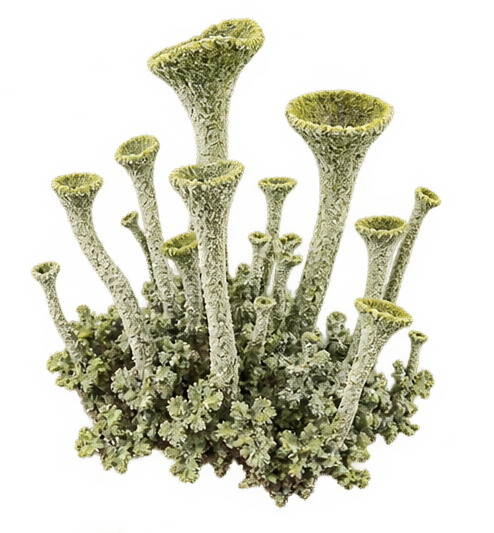
  9. Lichens are usually one species of fungus and one to two species of algae.
  10. Lichens are named after the fungus species.
  11. There are about 20,000 known species of Lichens.
  12. Lichens are a major winter food source for many animals.
  13. Lichens are used as nest materials for many birds.
  14. Lichens have been used to make bitter beers.
  15. Lichens were used to poison wolves and foxes in the 18th century in Europe.
  16. Lichens can be in various colors, ranging from bright yellow, red, and orange to green, black, brown, silver, and gray.
  17. Lichens are very strong and resillient.
  18. Lichens can grow on almost every surfaces.
  19. Lichen, in English, derives from the Greek λειχήν leichēn ('tree moss, lichen, lichen-like eruption on skin') via Latin lichen.
  20. Lichen's coloration is usually determined by the photosynthetic component.
  21. Lichens have been used to color paper and cloth in Icaland.
  22. Lichens are good for bloated stomachs and skins.
  23. Lichens do not have roots.
  24. Lichens protect trees and rocks from extreme weathers.
  25. Lichen growth and livelihoods can be affected by sulfur and heavy metal.
  26. Lichens are essential to many ecosystems
  27. Lichens's fungus provides a structure for the algae to live in, while the algae provide food for the fungus.
  28. Lichenometry is a scientific dating method that measures the size of lichen on rocks to find out how long the rock surface has been exposed.
  29. Lichens grow so slowly, some as slow as 0.5 mm per year.
  30. Many lichen species in Europe are endangered species.
  31. Many lichen species have declined or become locally extinct due to Industrialisation, due to polluted air.
  32. Lichens cover around 6% of the earth's land surface.
  33. Lichens are the simplest members of the plant kingdom.
  34. Lichens have been used as medicine since medieval times.
  35. Wandering lichens are not anchored to the ground. They curl up during dry spells and are blown across the desert floor by the wind.
  36. Lichens come in various shapes and forms; some are papery crust, others have long, hanging hairs, or tiny cups, or just look like a powdery coating.
  37. Ancient Egyptians used the lichen as a packing and embalming material for mummies.
  38. Fluorescent lichens grow in the dark.
  39. Lichen extracts are used to make the perfume base.
  40. The Pima Tribe of California traditionally used a type of lichen they called Earth Flower as a good luck charm.
  41. The Native American tribe, Apache, used lichens to paint crosses on their feet to pass by enemies unseen.
  42. The Kwakiult tribe of British Columbia used a type of lichen as a love charm.
  43. Dog Lichens are used to treat dog bites.
  44. Lichens are non-binary.
  45. Lichens are being researched to become hydrogen fuel for spaceships.
  46. Lichen was mentioned in William Shakespeare's The Comedy of Errors as idle moss.
  47. Lichens are, however, not moss.
  48. Many of the lichens were named after the part of the body they were believed to heal in the Middle Ages.
  49. Scientists and researchers who study lichens are called Lichenologists.
  50. Lichens are all around us.
x